Published paper
Vișan V.-Ș., Bîrchi E.-A. (2026). Acclimatization of Withania somnifera (L.) Dunal in Vâlcea County, Romania: overwintering, regrowth after repeated cutting, and the foliage and roots of second-season plants. International Scientific Symposium “Horticulture, Food and Environment – Priorities and perspectives”, University of Craiova, Faculty of Horticulture, 29–30 October 2026. Published in the symposium proceedings.
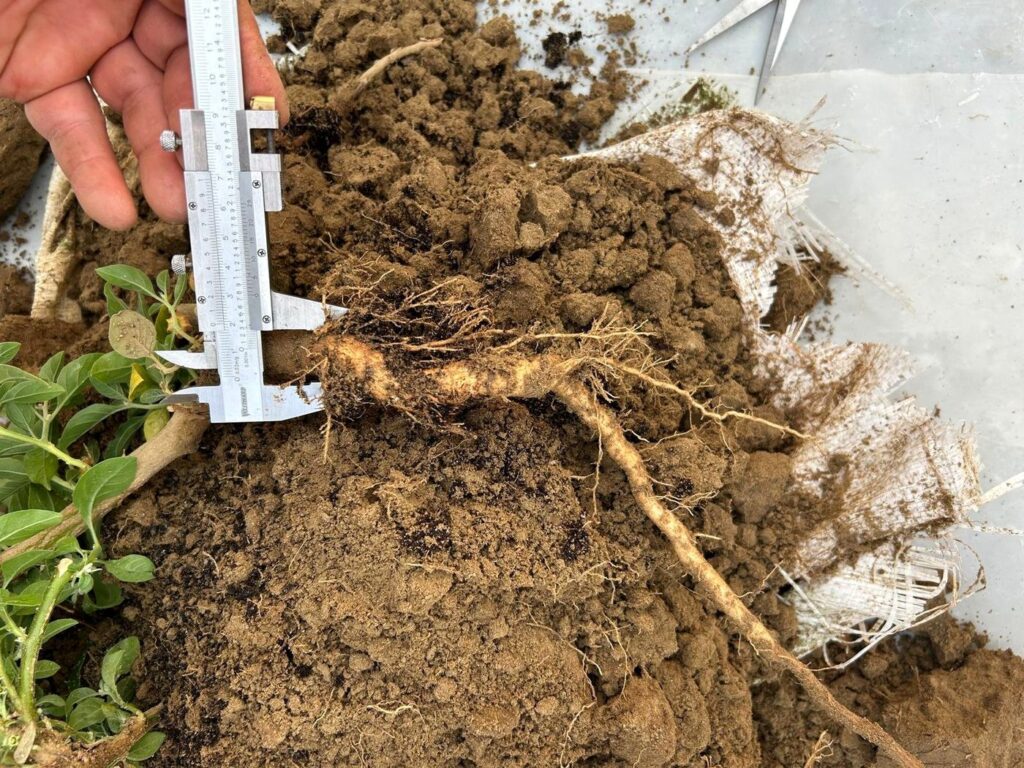
What it shows: of 100 plants overwintered with soil heating (estimated minimum at the collar about +2 °C), 80 survived; of 100 overwintered without heating, under a fleece cover (about −2 °C), 50 survived. The plants regrew from the collar in March 2026, and their own seed emerged at a rate of 60 in 100. After 16 months, the roots measured were at least 34–45 cm long, with collar diameters of 21–25 mm. Full record: Plant passport – ashwagandha.
Studies in progress
- Damiana and Turnera ulmifolia, two different species. We grow them under the same conditions and record how they differ in germination, propagation and development (2025–2026). The comparison.
- Baikal skullcap. Followed in protected cultivation alongside the other species in acclimatisation.
- The plant and its microbiome. Observations on living soil, compost, honey and wool.
Seed and plant material
- A living seed collection from the species we grow, shown at a separate stand at the Craiova symposium.
- Plant material donated for study to the University of Craiova: ashwagandha, damiana (Turnera diffusa), Turnera ulmifolia and Baikal skullcap.
- Turnera ulmifolia donated to partner schools, ten pots each, at the start of the 2026–2027 school year.
Support for students
A master’s thesis at “Alexandru Ioan Cuza” University of Iași, an applied study of Turnera diffusa; students from Craiova hosted at the base.
Education and community
- About 800 pupils in our workshops over two years. The activities are recorded in the partner schools’ reports.
- Almost 200 pupil and teacher visits in three weeks of October 2026, including an Erasmus+ group from four countries.
- The FAO posters for World Soil Day 2026, translated by us into Romanian.