Beica-Mădulari Community Association is a volunteer-run NGO in Vâlcea County, Romania. We study how medicinal plants grow, acclimatise and can be conserved, and we pass on what we learn free of charge — to pupils, adult learners, growers and researchers. We are new to European programmes and we say so plainly: this page lists our registrations, not grants. What we bring is a real site, real field records and a community that takes part.
Our European identifiers
- Erasmus+ and European Solidarity Corps – Organisation ID (OID): E10446535
- EU Funding & Tenders Portal – Participant Identification Code (PIC): 860103851
- EPALE, the Electronic Platform for Adult Learning in Europe – organisation profile published
- SALTO-YOUTH – registered organisation
- Signatory of the EU Mission Soil Manifesto (November 2026)
- Profile accepted in the civil society database of the UN Department of Economic and Social Affairs (November 2026)
- ISO 9001:2015 (quality) and ISO 14001:2015 (environment), valid until 28 May 2027
- Romanian tax ID (CIF): 31619695 · EORI: RO31619695 · Plant health registration: RO/VL/071/PIDO
What we are looking for now
Adult education – Erasmus+ small-scale partnership (KA210-ADU), spring 2027 round. Working title: “Learning with living soil: edaphic farming, composting and medicinal plants.” We are looking for one or two partners — NGOs, adult education providers, seed or soil networks, botanical gardens, organic farming associations — to build practical learning for adults, small farmers and educators on soil-friendly cultivation of medicinal plants. We are ready to coordinate.
School education. We are glad to join, as a partner, projects led by schools: our base already works as an outdoor classroom.
Soil and biodiversity. For partners working on the soil microbiome and the plant–soil relationship, we offer a site where cultivated plots lie next to natural habitats.
Our working themes
- Edaphic farming: cultivation that starts from the living network of organisms in the soil
- Composting and keeping organic matter in the cycle
- Allelopathy: how medicinal plants influence one another when grown together
- Sustainable use of soil and water
- The microbiome of soil and plant — the plant studied together with the life that accompanies it
- Acclimatisation of exotic medicinal species, season after season, including winter
- Seed production and a living seed collection
What we offer a partnership
Our theme: medicinal plants in a man-made environment – how they grow, adapt and influence one another in places shaped by people.
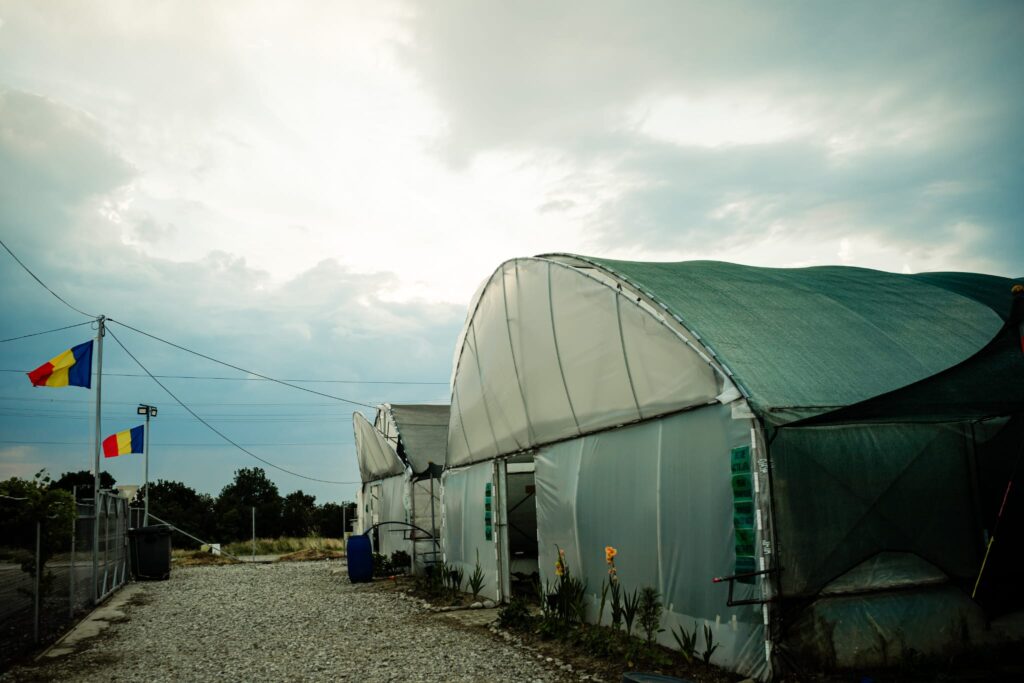
- A working base in Iacovile, Mădulari: 1,800 m² of protected cultivation in four growing units and 1,200 m² of semi-protected plots, at about 405 m altitude
- 17 medicinal species followed from seed, with our own records of germination, propagation, growth and overwintering
- Three exotic species in acclimatisation — ashwagandha (Withania somnifera), damiana (Turnera diffusa) and Baikal skullcap (Scutellaria baicalensis) — and a side-by-side comparison of Turnera diffusa and Turnera ulmifolia
- Access to natural habitats — forests and mountain land — through our agreement with Obștea Horezu, a community forest association
- Field learning in the Căpățânii Mountains
- A team of 35 volunteers and a village that takes part; accommodation with local families can be arranged
- Experience with learners: about 800 pupils in our workshops over two years. The activities are recorded in the partner schools’ reports. In October 2026 we hosted a visiting Erasmus+ group of 34 teachers and pupils from Slovenia, Portugal, Turkey and Romania
- Natural methods only: no synthetic fertilisers or chemical treatments
How our work connects to European priorities
- Soil health. We signed the EU Mission Soil Manifesto. Our base works as a small living lab: a real site, shared records, and a community that learns on it.
- Biodiversity and genetic resources. We produce seed from the species we grow and start from local plant populations. None of our 17 species is listed under CITES.
- Green skills in rural areas. Everything we teach is free: workshops for schools, meetings with the local community, knowledge transfer to anyone interested.
- UN Sustainable Development Goals. Our work contributes to Goal 4 (quality education), Goal 15 (life on land) and Goal 17 (partnerships).
Who we are, in short
Founded in 2013; since January 2025 focused on the applied study of medicinal plants. Run by volunteers and funded by sponsorship, with no government funding. Cooperation agreements with the University of Medicine and Pharmacy of Craiova, the University of Life Sciences “King Mihai I” in Timișoara, ICSI Râmnicu Vâlcea, the Vâlcea County Directorate for Agriculture and the Vâlcea Environmental Protection Agency. We also collaborate with the Faculty of Horticulture of the University of Craiova, at whose symposium our paper was published.
Practical information
- Where: Iacovile village, Mădulari commune, Vâlcea County, southern Romania (44.68°N, 24.10°E), about 10 km from Drăgășani and about 50 km from Râmnicu Vâlcea
- Nearest airports: Craiova, Sibiu, Bucharest
- Working languages: Romanian and English; Greek is also spoken in the team
- Legal representative: Eugenia Ioana Copoeru, President
- Contact for partnerships (English): Iacob Bogdan Vișan, Secretary — contact@beicamadulari.org · +40 723 132 354
Downloads
Journalists will find our boilerplate, quick facts and photographs on the Press and materials page.