
All data below come from the published paper.
| Species | Withania somnifera (L.) Dunal, family Solanaceae |
| Group | Exotic species in acclimatisation |
| Seed origin | Accredited commercial supplier in the United Kingdom; lot declared to the Romanian plant health authority (RO/VL/071/PIDO) |
| Site | Base in Iacovile, Mădulari, Vâlcea County, Romania; 44.68°N, 24.10°E; about 405 m altitude; temperate-continental climate |
| Growing system | 30-litre cultivation bags in a polyethylene tunnel; sandy, free-draining soil |
Observed calendar
| When | What we observed |
|---|---|
| Spring 2025 | sowing; seedlings raised for about 45 days |
| 1 June 2025 | planting into bags |
| November 2025 | plants go dormant; watering stops for the winter |
| March 2026 | plants regrow, mainly from the collar |
| 2026 | second season: flowering, fruiting and seed |
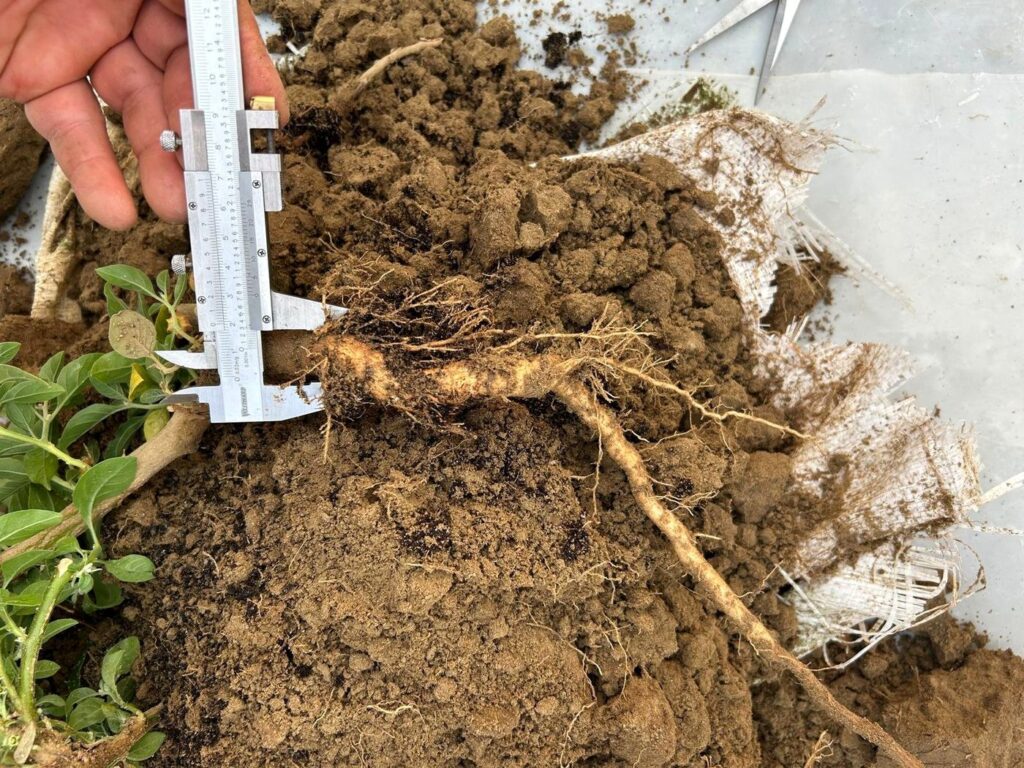
| 6 October 2026 | first roots lifted from the bags and measured, 16 months after planting |
Results
| What we followed | Result |
|---|---|
| Overwintering, lot with soil heating (estimated minimum at the collar: about +2 °C) | 80 of 100 plants survived |
| Overwintering, unheated lot under a fleece cover (about −2 °C) | 50 of 100 plants survived |
| One plant left outdoors without protection | did not survive |
| Emergence of our own 2026 seed | 60 in 100 |
| Roots at 16 months (four plants from bags) | at least 34–45 cm long; collar diameter 21–25 mm; fresh mass 23.5–36.5 g |
The temperatures are estimates at the collar, not continuous measurements. There was one lot per treatment and plants were not allocated at random, so the comparison is an observation, not an experiment. The trial is being repeated in winter 2026–2027 with replicated zones and continuous temperature logging.
Other observations
- Two plant types occur in the crop, in a ratio of about 70 to 30: one with smaller, strongly scented leaves and more flowers; the other with more moderate, steady growth.
- The plants tolerated removal of the whole aerial part, about 10 cm above the soil, roughly every three months.
- They are very sensitive to water shortage and grew better in sandy substrate than in humus-rich substrate.
- The shape of the roots shows that the bag restricted their growth.
- Pests observed on the leaves: whiteflies and spider mites.
What we do not know yet
- Why plants were lost over winter: cold itself, or disease in cold, damp conditions.
- How the plants come through a third winter.
- The composition of leaves and roots of second-season plants; the analysis is proposed, not yet done.
- Whether the two plant types behave differently.
Source of data — Vișan V.-Ș., Bîrchi E.-A. (2026), paper published in the proceedings of the symposium at the University of Craiova (see “Results and publications”).
This record describes cultivation observations. It contains no recommendations for use and no health claims.